On Passover we remember our people’s deliverance from Egypt, when our God saved us and we were freed to be our own nation rather than a nation of slaves.
To me, Passover is more than a day to feast. I am devoted to my people Israel, and remembering the miracles that God did through Moses gives me hope in this time of Roman oppression. My entire life has been devoted to the overthrow of the Roman government, protesting their unjust taxes and rallying support for Israel.
So, when I met the new Moses, I began following him immediately.
This quiet carpenter from Nazareth came and declared that our God had sent him to establish a new kingdom. I eagerly began following this man, hoping to be by his side when it came time to overthrow the Romans.

After three years of following Jesus, he and all of us apostles gathered in a borrowed upstairs room to observe Passover. Our meal was simple – just bread and wine. It was the most modest Passover I’d participated in, but the significance of that day shone brighter than ever. Before saying the traditional Shabbat blessing over the bread and wine, Jesus leaned back and said to us, “I have eagerly desired to eat this Passover with you before I suffer. For I tell you, I will not eat it again until it finds fulfillment in the kingdom of God” (Luke 22:15-16, NIV). My heart jumped. Before next Passover, the new kingdom would be established! I prepared myself for the battle that would be required to bring about such a quick transition.
Then he took the bread and said, “This is my body given for you; do this in remembrance of me.” And he took the wine and said, “This cup is the new covenant in my blood, which is poured out for you” (Luke 22:19-20, NIV).

What was he saying?
When we had finished with the meal, Jesus said, “If you love me, keep my commands. And I will ask the Father, and he will give you another advocate to help you and be with you forever – the Spirit of truth. The world cannot accept him, because it neither sees him nor knows him. But you know him, for he lives with you and will be in you. I will not leave you as orphans; I will come to you. Before long, the world will not see me anymore, but you will see me.”
This confused me more than any of the bizarre things he had ever said. I spoke up, asking, “But, Lord, why do you intend to show yourself to us and not to the world?” How could he establish a new kingdom if nobody knew him? You can’t lead a nation without followers who see and know you.
“Anyone who loves me will obey my teaching. My Father will love them, and we will come to them and make our home with them. Anyone who does not love me will not obey my teaching.” Well, that’s a terrible plan, I thought. Whoever wants to follow him will and whoever doesn’t won’t? Not a very stable plan for a government. But then, I would have thought Moses was crazy, too, until I saw the sea part. I just had to trust this man and wait to witness a miracle (John 14:15-24, NIV).
Of course, you know how the story goes. The miracle that I expected to see was not the one that came to pass. My zeal for a new Israel was misplaced and Jesus didn’t overthrow the Roman government. He was killed.
But then, three days after he was pronounced dead, came the miracle I never expected.
Our friend Cleopas came to the apostles and told us an amazing story. He had invited a lone traveler to join him for dinner, and as the traveler broke bread, suddenly he recognized him. As the man reached out to distribute the bread for the meal, Cleopas saw in his eyes the man we’d hoped would redeem Israel – Jesus. Cleopas gasped and dropped his bread, and then Jesus was gone (Luke 24:13-35).
We sat discussing this incredible account, wondering what to make of it. We were all arguing and yelling when suddenly a quiet voice broke through the chaos saying, “Peace be with you.” In amazement, we all turned to see Jesus standing in the room – a real, tangible presence. He told us again the things he had tried to teach us before, but had been too stubborn to accept. He told us, “This is what is written: The Messiah will suffer and rise from the dead on the third day, and repentance for the forgiveness of sins will be preached in his name to all nations, beginning at Jerusalem.” And shortly after, he ascended back into heaven (Luke 24:36, 46-47, NIV).
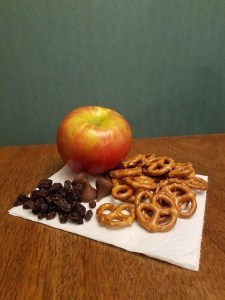
This was all very bewildering to me at the time, but upon reflection, I’ve begun to make sense of it. It all comes back to that most extraordinary of Passover meals. There was no lamb or olives or grape leaves or dates. But that isn’t what makes it a meal. As long as there is bread and wine, there is a meal. These are the essential components of dinner; everything else is extra. That is why we bless the bread and wine before eating – it represents the meal in its entirety. When we recite a prayer over these simple items, that prayer finds its way to the lamb and the olives and the grape leaves and the dates. People argue to this day about what Jesus meant when he said that the bread was his body and the wine his blood. I may not understand most, if any, of what he said, but I think I understand, at least to some extent, what he was trying to tell us a that Passover meal.
In my political zeal, I had made Jesus out to be something spectacular and dazzling. A warrior. A king. In my mind, he was the lamb at the center of the table – the most mouth-watering and elaborate part of the meal.
But he declared himself to be something much more simple and elemental than that. Bread and wine. Food we eat every day, not only at celebrations and feasts. Simple but powerful. Ever-present. And vital to survival. A simple morsel we eat every day in order to stay alive. It was manna that kept our people alive after they were freed from Egypt. Ordinary, bland food. The same thing everyday. It wasn’t spectacular or dazzling at all.
And, as the central and essential element of the meal, Jesus is the vessel through which each of us is blessed. If he is the bread and wine, then we are all of the other morsels which receive blessing via his blessing.
He was not the radical I expected him to be. Rome continued to thrive, a very strong empire for a very long time. And yet, because of the simple power of Jesus, a new kingdom was established for those of us who choose to submit to his simple but ubiquitous presence.
 Neglected Word