“Or suppose a woman has ten silver coins and loses one. Doesn’t she light a lamp, sweep the house and search carefully until she finds it? And when she finds it, she calls her friends and neighbors together and says, ‘Rejoice with me; I have found my lost coin.’ In the same way, I tell you, there is rejoicing in the presence of the angels of God over one sinner who repents.” (Luke 15:8-10)
The Parable of the Lost Coin is sandwiched between two other very familiar parables: the Parable of the Lost Sheep and the Parable of the Lost Son. We often hear God described as a shepherd boy who leaves the 99 to chase after the one sheep who ran away, doing whatever it takes to bring his beloved sheep back to himself. Also familiar is the image of God as a loving father who happily embraces his returning prodigal son, his love undiminished by the son’s reckless behavior.
Rarely do we see the image of God as a woman in financial distress.

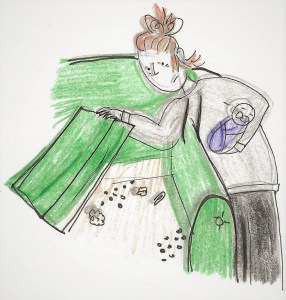
In this parable, the woman has misplaced a drachma, worth about a day’s wages. That’s a significant sum of money. She recognizes the worth of this coin and scours the house looking for it. She lights a lamp and sweeps the house. She overturns couch cushions. She pulls all of the food from the fridge in case she put it there by mistake. She retraces her steps, looking under tables and on top of high shelves.
And then, out of the corner of her eye, she spots a glint of light, and turns to find the coin. She is overcome with relief. Finally, she found it. She’s so glad that she found her lost coin that she calls her friends and neighbors. “You guys, I thought I lost a whole drachma, but I found it!” She is overjoyed because this thing of great value has been returned to her.

We aren’t told specifics about this woman’s background. Maybe she’s a single mom who has a hard time providing for her kids, and losing this money would be a devastating blow. Maybe she’s an entrepreneur who needs to pay off her start-up loans. Maybe she’s a student saving up for college. Maybe she’s homeless and trying to make a way for herself. Maybe her sister is in jail and she needs to bail her out. Maybe she’s become terribly ill and needs to pay for a life-saving operation.
Whatever the case, we must recognize this parable’s place in the gospels. Sandwiched between two other illustrations of God’s relentless pursuit of us, we shouldn’t dismiss this imagery of God.
God is a frazzled mom looking out for her children.
God is a driven woman taking care of her creation.
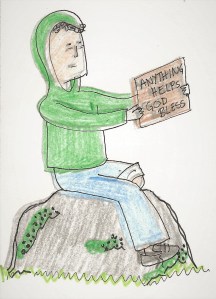
God is a frightened woman who doesn’t know what her future holds.
God is reflected in each and every one of us. The image of God isn’t so singular as a grey-haired, bearded, elderly man (although, his image is certainly reflected in these individuals as well). God is vast. God is woman and man and everything in between and beyond.
But whether God is depicted as a shepherd boy, a grieving father, or a frazzled woman, one thing is certain: She sees great value in us and loves us enough to pursue us until we are safely back in her hands.
Credit to Amy Jill-Levine for pointing out that this parable is describing God as a woman in a talk I heard her give at Gonzaga University in February 2016.
 Neglected Word