“Sheshan was the father of Ahlai….Sheshan had no sons – only daughters. He had an Egyptian servant named Jarha. Sheshan gave his daughter in marriage to his servant Jarha, and she bore him Attai.” – 1 Chronicles 2:31, 34-35
My great-great-great-great-great-great-great-great grandmother Tamar made a name for herself. My great-great-great-great-great-great-great-great grandfather Judah had tried to keep his son, who should have been her husband, away from her. He denied her the right to bear children, to have a family, and to have the protections that come with a family. So she tricked Judah into becoming the father of her children and he confessed that she had done what was right when he had done what was wrong.
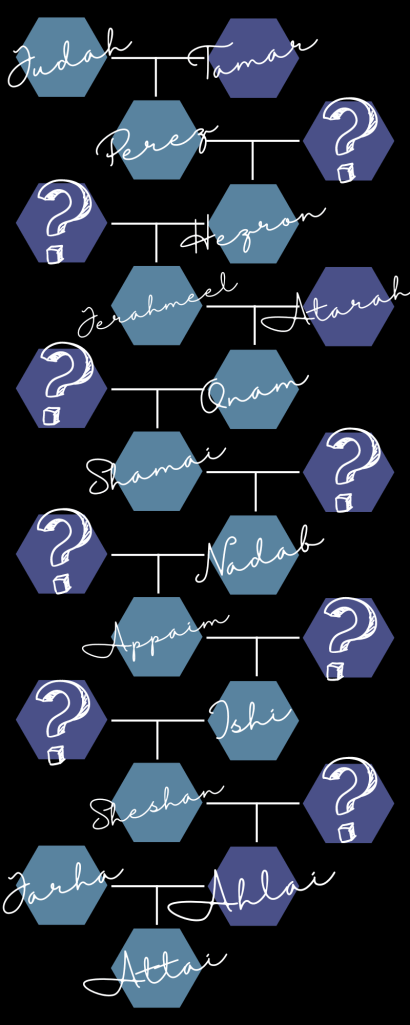
Grandma Tamar gave birth to a son named Perez. Perez was the father of Hezron who was the father or Jerahmeel. Jerahmeel married Atarah and she gave birth to Onam, the father of Shammai, the father of Nadab, the father of Appaim, the father of Ishi, the father of Sheshan the father of me.
Eleven generations.
Three named women.
Of course, we all know that the men in this genealogy would not exist without women. Yet, most of the women in my ancestry are forgotten. I do not know their names, much less anything about them. They were used for reproduction but not credited for it.
My name would have been forgotten, too, had I had any brothers. But my father had no sons to inherit his land. I thought, being the eldest daughter, that perhaps I would inherit his land. Such things had happened in the history of my people before. But my father would rather pass his inheritance to his indentured servant than his daughter.
I was married off to my father’s Egyptian servant, Jarha. Perhaps my father was progressive in his inclusion of foreigners in Israel’s land and genealogy. I hold nothing against my husband for his country. Perhaps I even loved him. But he acted as a replacement for the son I could never be.
Yes, the text gives me a name. But it records my name not to acknowledge me as a person in my own right. I am remembered as a daughter, a wife, and a mother. An awkward technicality in a long line of men.
To be sure, I was a daughter. A wife. A mother. And I was a person. A full human being with hopes and thoughts. I loved my family. Not only the men in my family, but the women as well. My mother, whom the text does not name. My sisters. My daughters. My granddaughters. My friends and teachers. My father’s female servants. All with lives as rich as mine.
So, although the text does not see them as worthy to name or remember, I do. I remember them.
Sources:
“1 and 2 Chronicles” by Christine Mitchell in Women’s Bible Commentary
The Hebrew Bible: A Translation with Commentary by Robert Alter
Read more about Tamar – Genesis 38
Read more about women inheriting – Numbers 27:1-11
 Neglected Word